


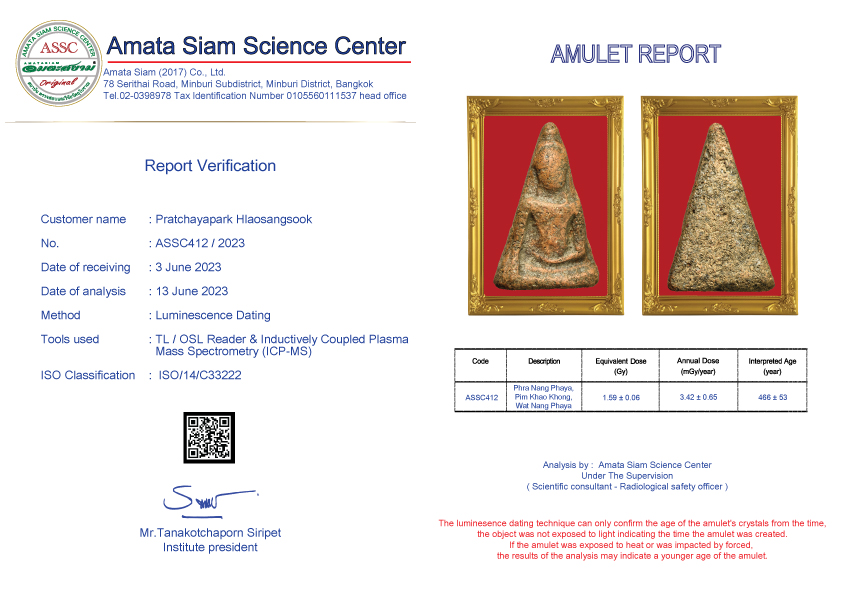
Origin and Creation:
The Phra Nang Phaya amulets originated during the Ayutthaya Period, specifically around 1548–1563 AD (approx. 2090–2105 BE). According to historical consensus and local chronicles, the creation was commissioned by Queen Wisutthi Kasattri, the royal consort of King Maha Thammaracha and the esteemed mother of King Naresuan the Great. The amulets were consecrated and enshrined within the central stupa (chedi) of Wat Nang Phaya in Phitsanulok Province to ensure spiritual protection and the prosperity of the Buddhist faith.
| Topic | Description |
| Founder | Queen Wisutkasat, the royal consort of King Maha Thammaracha. |
| Historical Role | She was the mother of King Naresuan the Great. |
| Construction Period | Mid-Ayutthaya Period, around B.E. 2090 – 2100. |
| Purpose | To be enshrined in the stupa of Wat Nang Phaya as a royal merit-making. |
| Location | Wat Nang Phaya, Phitsanulok Province (near Wat Phra Si Rattana Mahathat). |
| Artistic Style | Ayutthaya Mixed with Sukhothai (The “Queen” style). |
| Material Composition | Fine-grained baked clay mixed with sacred sand and minerals. |
Discovery History:
The primary discovery, known as the “Gru” opening, occurred in 1901 AD (2444 BE) during the reign of King Chulalongkorn (Rama V). The discovery took place while the temple grounds were being prepared for the Royal Visit to witness the casting of the Phra Buddha Chinnarat replica. A vast quantity of these triangular earthen amulets was unearthed from the collapsed foundation of the ancient stupa. Upon discovery, the temple presented the amulets to King Rama V, who subsequently bestowed them upon the royal entourage and high-ranking officials.
| Topic | Description |
| Origin | Wat Nang Phaya, Phitsanulok Province. |
| Estimated Age | Approx. 400 – 500 years (Ayutthaya Period). |
| Major Discovery | Found in 1901 (B.E. 2444) during the visit of King Rama V. |
| Historical Creator | Believed to be created by Queen Wisutkasat. |
| Discovery Context | Found buried within the collapsed pagoda (stupa) area. |
| Subsequent Discoveries | Found again in 1944 (B.E. 2487) and later in the temple grounds. |
Buddha Characteristics & Artistic Style:
Phra Nang Phaya is characterized by its distinct equilateral triangular shape. The artistic style represents the transition between the Sukhothai and Ayutthaya schools of art. The Buddha is depicted in the Subduing Mara (Maravijaya) posture, seated on a simple raised base without a decorative throne. The elegance of the slender limbs and the serene facial expression reflect the high craftsmanship of the royal artisans of that era.
| Feature | Description |
| Shape | Distinctive Isosceles Triangle with a flat base and tapered top. |
| Posture | Pang Maravijaya (Victory over Mara), seated in a cross-legged position. |
| Face | Oval or heart-shaped, influenced by Sukhothai Art, showing elegance. |
| Torso | Broad chest with a slim waist, creating a “V” shape or “Athletic” look. |
| Arms | The right arm is long and curves gracefully down to the right knee. |
| Halo/Ears | Long, slender ears that stretch down near the shoulders. |
| Artistic Essence | A blend of Sukhothai and Ayutthaya styles, reflecting royalty. |
| Texture | “Nua Din” (Baked Clay) – grainy texture with visible minerals (sand and gravel). |
Scientific Dating using OSL and LA-ICP-MS:
The Phra Nang Phaya, known as the “Queen of Amulets” from the Ayutthaya period, is traditionally authenticated by visual inspection. However, modern scientific methods provide undeniable proof of its age and material composition:
1. OSL (Optically Stimulated Luminescence Dating)
- The Science: This technique measures the time elapsed since the clay was last exposed to high heat (fired in a kiln). Clay contains minerals like Quartz that trap ambient radiation over centuries.
- The Result: For an authentic Phra Nang Phaya, the OSL test should yield a date of approximately 400–500 years, confirming its creation during the 21st–22nd Buddhist Century (the reign of King Maha Thammaracha). This distinguishes ancient artifacts from modern replicas.
2. LA-ICP-MS (Laser Ablation-ductively Coupled Plasma Mass Spectrometry)
- The Science: This is a high-precision elemental analysis that can detect chemical “fingerprints” at the parts-per-billion (ppb) level.
- The Result: * Geological Origin: It confirms if the clay’s mineral profile matches the soil of the Phitsanulok region.
- Purity Check: It detects modern synthetic materials, chemical binders, or industrial pigments. Authentic ancient amulets will only show natural mineral elements without any 20th-century chemical additives.
| Method | Measurement |
| OSL Dating | Accumulated Energy in minerals (Quartz/Feldspar) from the last firing. |
| LA-ICP-MS Analysis | Elemental Fingerprint and trace elements at parts-per-billion (ppb). |
| Purity Check | Detection of Modern Polymers or synthetic binders. |
| Digital Twin | Linking physical lab results to the Blockchain/NFT. |
Spiritual Attributes & Beliefs:
“Phra Nang Phaya is revered as the ‘Queen of Amulets’ within the prestigious Benjapakee set. Originating from the Ayutthaya period, this sacred icon is believed to bestow supreme Metta Mahaniyom (Compassion & Popularity) and Maha Amnat (Great Authority) upon its possessor. It is highly sought after by leaders and executives for its perceived power to enhance leadership charisma, command respect, and ensure triumph over all obstacles. Beyond its protective grace (Klaew Klaad), it serves as a symbol of feminine strength and divine prosperity, bridging ancient spiritual protection with timeless elegance.”
| Topic | Description |
| Metta Mahaniyom | Loving-Kindness & Charm: Making the wearer beloved and well-received by others. |
| Maha Amnat | Supreme Authority: Enhancing leadership, power, and the ability to command respect. |
| Klaew Klaad | Miraculous Evasion: Protecting the wearer from accidents, dangers, and unseen obstacles. |
| Victory & Success | Barami & Victory: Helping the wearer achieve triumph in negotiations and life goals. |
| Protection | Superior Protection: Safeguarding against physical harm and spiritual negativity. |
| Queen of Power | Special Attribute: Highly recommended for women in leadership or executive roles. |