

- March 21, 2026
- Posted by: amatasiamcorpltd
- Category: Blockchain, NFT
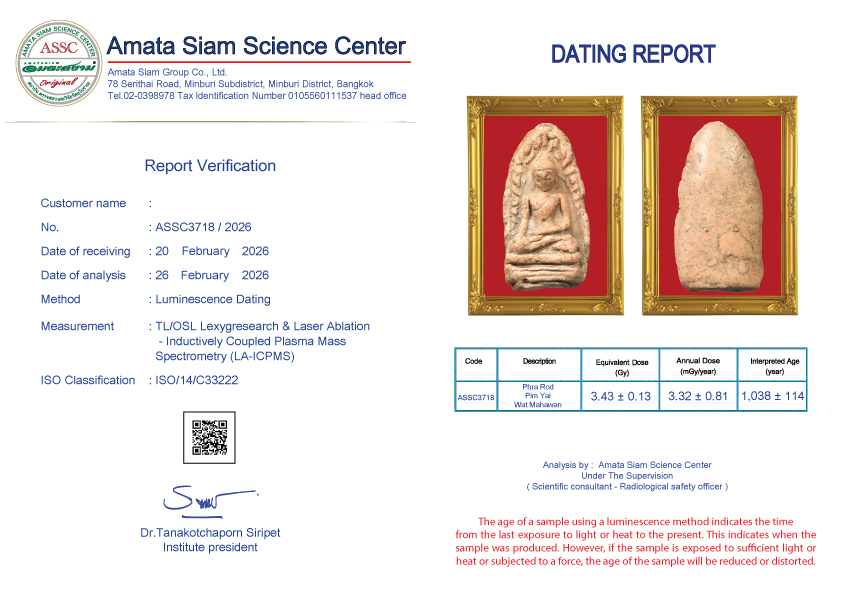
Origin and Creation:
Phra Rod is the oldest amulet in the Benjapakee set, dating back to the Hariphunchai Period (approx. 1,200–1,400 years ago). It was created during the reign of Queen Chamadevi, the first ruler of Hariphunchai (modern-day Lamphun). According to ancient chronicles, the amulets were consecrated by Rishi Narada (Phra Ruesi Narot) to be enshrined in the four corners of the city for spiritual protection.
| Topic | Description |
| Founder | Hermit Naratha (Phra Reusi Narot), one of the great ancient ascetics. |
| Patron | Queen Chamadevi, the first ruler of the Haripunchai Kingdom. |
| Construction Period | Dvaravati – Haripunchai Era, approximately 1,200 – 1,300 years ago. |
| Purpose | To be distributed to soldiers for protection and enshrined in the temple to sustain Buddhism. |
| Location | Wat Mahawan, Lamphun Province (The oldest temple in the city). |
| Material Composition | Baked clay mixed with sacred herbs and minerals, often showing diverse colors due to ancient firing. |
| Artistic Style | Pure Dvaravati – Haripunchai Art, featuring Bodhi leaf arch designs. |
Discovery History:
The primary discovery occurred in 1908 (B.E. 2451). The old pagoda (stupa) at Wat Mahawan collapsed due to its age. During the subsequent restoration and debris clearing, a large quantity of clay-baked amulets was found buried within the base of the stupa. These amulets were named “Phra Rod” (meaning “survival” or “miraculously saved”).
Later, in 1955 (B.E. 2498), another major discovery happened when the temple dug a drainage ditch, uncovering more amulets buried deep in the ground around the temple area. These are often referred to as the “Kru Kao” (Old Group) and “Kru Mai” (New Group) discoveries.
| Period | Event & Context |
| Early Discovery (Late 19th Century) | The first formal discovery occurred in 1892 (B.E. 2435) during the reign of King Rama V when the main pagoda collapsed. |
| Major Restoration (1908) | During a major renovation in 1908 (B.E. 2451), a vast number of amulets were found buried under the foundation of the old pagoda. |
| The 1955 Discovery | A significant amount of Phra Rod was unearthed during the renovation of the temple’s flooring and surrounding walls. |
| Post-1955 Excavations | Small batches continued to be found during minor repairs within the temple grounds over subsequent decades. |
| Crypt Condition | The amulets were found inside earthen jars and scattered within the debris of the ancient stupa. |
Buddha Characteristics & Artistic Style:
Phra Rod is renowned for its unique artistic style, reflecting the Hariphunchai art period. The key characteristics are as follows:
- Pang Maravijaya (The Victory over Mara): The Buddha is depicted in a seated position, performing the Maravijaya mudra (touching the earth with the right hand).
- Amulet Shape: It has a distinct “tapered top” or “bullet-like” shape, with a flat base. The overall form is slim and elegant.
- The Halo (Bodhi Leaves): One of the most striking features is the detailed “Bodhi leaves” or flame-like halo surrounding the Buddha’s head and body, symbolizing enlightenment and protection.
- Facial Features: The face is typically oval with a calm expression, often showing a prominent nose and well-defined ears (Phra Karna) that reach down to the shoulders.
- Material: Made from very fine-grained “baked clay.” Due to the ancient firing process, the amulets come in various colors such as yellow, green, red, and white, and the texture is exceptionally hard and dense.
The “Narak” (The Fingerprint/Mark): On the base or back of authentic pieces, there are often subtle marks or “cracks” caused by the ancient pressing and drying process, which are key indicators for authentication.
| Feature | Description |
| Shape | Small, Leaf-shaped or tapered at the top with a rounded base. |
| Posture | Pang Maravijaya (Victory over Mara), seated on a multi-tiered pedestal. |
| Artistic Style | Dvaravati – Haripunchai Style, showing ancient and powerful aesthetics. |
| The Arch | Seated under a Bodhi Leaf Arch with delicate vein-like patterns. |
| Face | Distinctive features with a broad forehead and long, prominent nose. |
| Ears | Long ears stretching down, with the left ear often touching the shoulder. |
| Base | Typically features 4-tier pedestals, looking like stacked layers. |
| Texture | Extremely fine clay, very hard (fired), and often has a “silky” smooth surface. |
Scientific Dating using OSL and LA-ICP-MS Techniques:
To verify the age and authenticity of ancient clay amulets like Phra Rod, two advanced scientific methods are predominantly used:
1. OSL (Optically Stimulated Luminescence Dating)
- Principle: This method measures the last time the clay was exposed to intense heat (fired in a kiln) or sunlight. It calculates the “trapped electrons” within the mineral grains (like quartz or feldspar) in the clay.
- Application: Since Phra Rod is a baked-clay amulet, OSL can determine the absolute age (number of years ago) the amulet was fired. If the result points back ~1,200 years, it aligns with the Hariphunchai period.
2. LA-ICP-MS (Laser Ablation Inductively Coupled Plasma Mass Spectrometry)
- Principle: A high-precision technique used for elemental analysis. It can detect trace elements and “chemical signatures” within the clay material at parts per billion (ppb) levels.
Application: This acts as a “chemical fingerprint.” It can identify if the clay’s mineral composition matches the soil from the Wat Mahawan area in Lamphun. It also detects modern chemical additives; if modern polymers or synthetic dyes are found, the amulet is identified as a contemporary reproduction.
| Method | Measurement | Significance for Phra Rod |
| OSL Dating | Thermoluminescence energy trapped in mineral grains (Quartz). | Confirms 1,200+ Years: Distinguishes genuine Haripunchai artifacts from modern recreations. |
| ICP-MS Analysis | Rare Earth Elements (REE) and trace minerals in the clay. | Geological Signature: Verifies if the clay source is from the Lamphun/Northern Thailand basin. |
| Mineralization Study | The growth of Calcite or Mineral crusts on the surface. | Aging Process: Confirms natural chemical changes that only occur over a millennium. |
| Non-Destructive XRF | Elemental concentration of iron, magnesium, and silica. | Composition Analysis: Ensures the material matches the “Ancient Clay” standard of Wat Mahawan. |
Spiritual Attributes & Beliefs:
Phra Rod (Wat Mahawan) The Amulet of Escape and Protection
1. The Meaning of the Name
The word “Rod” (รอด) in Thai means “to survive,” “to escape,” or “to be safe.” Therefore, this amulet is primarily known as the “Buddha of Escape.”
2. Core Beliefs & Powers
The spiritual powers of Phra Rod are often categorized into three main areas:
- Kong Grapan Chadtri (Invulnerability): Believed to protect the wearer from physical harm, sharp objects, and accidents.
- Klaew Klaad (Evasion): The power to miraculously escape from dangerous situations, disasters, or life-threatening events.
- Metta Mahaniyom (Loving-Kindness): It is also believed to bring charm and mercy, making the wearer liked and respected by others, which helps in avoiding conflicts.
| Topic | Description |
| Klaew Klaad | Miraculous Evasion: The primary power of Phra Rod is the ability to help the wearer escape from all forms of danger. |
| Victory & Success | Triumph over Obstacles: Based on the name “Rod” (meaning to survive or pass), it helps the wearer overcome life’s challenges. |
| Metta Mahaniyom | Loving-Kindness: Bringing mercy and being well-liked by people of all levels, from superiors to subordinates. |
| Protection | Invulnerability: Belief in protection against accidents and physical harm during travels or high-risk situations. |
| Spiritual Peace | Calming Energy: Due to its creation by ancient ascetics, it is believed to bring inner peace and mindfulness. |
| Endurance | Power of Survival: Helping the wearer remain resilient and “survive” even in the most difficult business or personal crises. |