

- April 7, 2026
- Posted by: amatasiamcorpltd
- Category: Blockchain, NFT
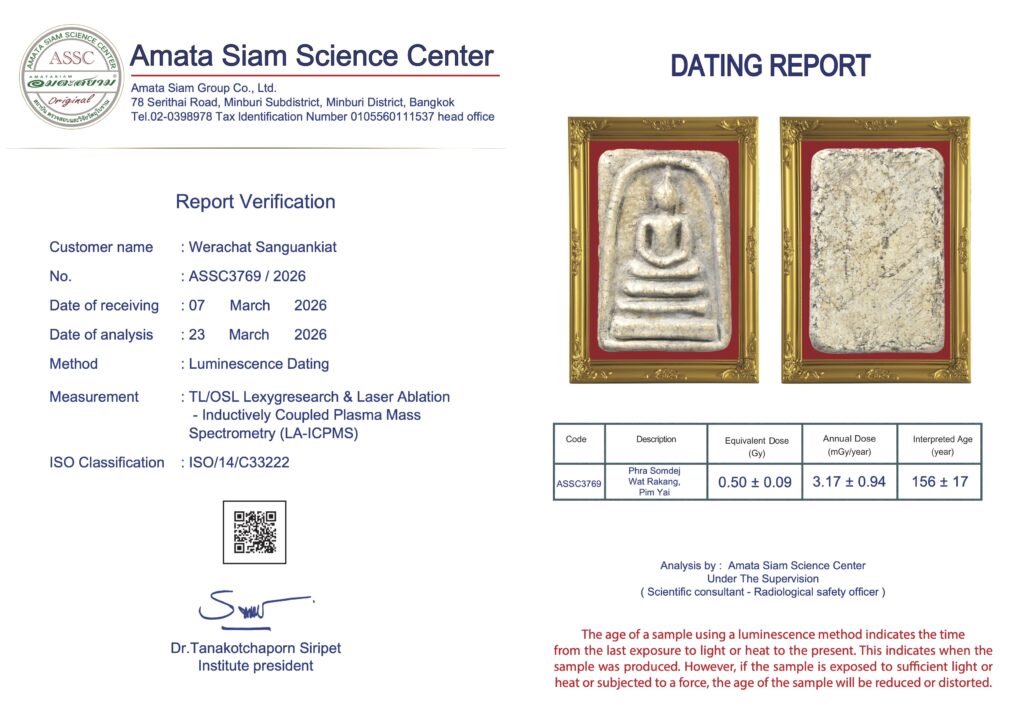
Origin and Creation:
Phra Somdej Wat Rakang was created during the Rattanakosin Period, specifically during the reign of King Rama IV. These sacred amulets were meticulously handcrafted and consecrated by the Most Venerable Somdej Phra Putthajarn (Toh Phromrangsi), one of the most revered monks in Thai history. The creation occurred primarily between 1866–1871 AD (2409–2414 BE). Unlike many other amulets found in pagodas, Phra Somdej was distributed by the master himself as a gift of faith and protection to the people.
| Topic | Description |
| Creator | The Most Venerable Somdej Phra Putthajarn (Toh Phromrangsi), the former abbot of Wat Rakang. |
| Era | Rattanakosin Era, during the reigns of King Rama IV and King Rama V. |
| Creation Period | Primarily between 1866 – 1872 (B.E. 2409 – 2415). |
| Materials | Limestone (shell lime) mixed with 5 Sacred Powders, dried rice, and diverse holy minerals. |
| The 5 Sacred Powders | Pathamang, Itthijae, Maharaj, Buddhakhun, and Trinisinghae powders. |
| Philosophy | Created to be distributed to people for protection and to remind them of the Buddha’s teachings. |
| Artistic Design | Minimalist and graceful, attributed to Luang Vijarn Jiarai, a royal court artisan. |
Discovery History:
Unlike the other members of the Benjapakee set, which were rediscovered after being buried in ancient pagodas for centuries, Phra Somdej Wat Rakang was never “lost.” These amulets were created and distributed directly by Somdej Phra Buddhacharn (Toh Bramaransi) between B.E. 2409 and 2415.
The “discovery” of these amulets usually falls into two categories:
- Hand-to-Hand Succession: Most authentic pieces were handed down through generations of noble families, royal court officials, and disciples who received them directly from Somdej Toh.
- Temple Storage: After Somdej Toh passed away, remaining amulets were found stored in the Ho Trai (Sermon Hall) and the ceilings of the temple buildings at Wat Rakang Khositaram. These were gradually released to the public during temple renovations.
Because they were not buried underground, they lack the heavy mineral crusts (Kru stains) seen on Phra Rod or Phra Soom Kor, making their “clean” but aged surface a primary point of identification.
| Topic | Description |
| Discovery Type | “Phra Ban” (House Amulet): Not a buried treasure, but a continuously possessed heirloom. |
| Direct Distribution | Distributed by Somdej Toh himself to disciples and the public between 1866–1872. |
| Temple Findings | Small batches were found stored in the Ho Trai (Library) and under the ceilings of Wat Rakang during renovations. |
| Surface Condition | Clean Surface: No heavy crypt stains (Kru stains) because they were not buried in soil or pagodas. |
| Succession Path | Passed down primarily through noble families, royal officials, and high-ranking monks. |
| First Public Fame | Gained widespread national fame shortly after Somdej Toh’s passing in the late 19th century. |
Buddha Characteristics & Artistic Style:
The artistic essence of Phra Somdej Wat Rakang represents the pinnacle of Rattanakosin era minimalist art. The overall shape is a perfect rectangular frame, often compared to a “piece of cake” (Chin-Phak), which symbolically represents the Four Noble Truths. Within this frame sits the Buddha figure in a serene meditation posture, encased by a thick, rounded bell-shaped arch (Sum-Kครอบแก้ว) that resembles a rainbow, providing a sense of divine protection.
The Buddha silhouette itself is highly abstract, featuring no facial features like eyes, nose, or mouth, which emphasizes the purity of the Dhamma. The torso is typically shaped like a V-style or barrel-chest, tapering down to a slim waist, sitting atop a three-tiered base that represents the Triple Gem (Buddha, Dhamma, and Sangha). The texture of the amulet, known as “Nua Num” (Soft Texture), is a result of the masterpiece blend of shell lime and Tung oil. Over time, the surface develops natural wrinkles, “crab’s eye” pits, and a “living” patina that makes each piece unique as it ages.
| Topic | Description |
| Overall Shape | Rectangular “Chin-Phak” frame, symbolizing the Four Noble Truths. |
| The Arch (Sum) | Bell-Shaped Arch: A thick, rounded rainbow-like curve providing a protective aura. |
| The Buddha Figure | Abstract Minimalism: Features no eyes, nose, or mouth, focusing on spiritual purity. |
| Chest (Ura) | V-Shape or Barrel Style: Broad chest tapering down to a slim, elegant waistline. |
| The Base (Thaan) | Three-Tiered Base: Representing the Triple Gem (Buddha, Dhamma, Sangha). |
| Material Texture | “Nua Num” (Soft Texture): Aged shell lime mixed with Tung oil, creating a “living” patina. |
| Back Surface | Features “Crab’s Eye” (tiny pits) or “Water Ripples” from natural dehydration. |
Scientific Dating using OSL and ICP-MS:
The scientific authentication of Phra Somdej Wat Rakang represents a shift from subjective “eye-judging” to empirical data. Using Optically Stimulated Luminescence (OSL), scientists can determine the last time the materials were exposed to intense light or heat. Since Phra Somdej is a lime-based amulet (made from crushed sea shells) that did not undergo high-heat firing like clay amulets, OSL is used to analyze the sedimentation age or the “re-crystallization” period of the calcium carbonate since it was molded approximately 150–160 years ago. This effectively distinguishes authentic 19th-century pieces from modern chemical-pressed imitations.
Furthermore, Raser Ablation-Inductively Coupled Plasma Mass Spectrometry (ICP-MS) acts as a chemical “biopsy” of the amulet. This technique analyzes the trace elements and rare earth minerals within the shell lime. Because the shells and minerals used by Somdej Toh were sourced from specific geological areas in the mid-19th century, the chemical profile must match known authentic standards. ICP-MS can also detect the specific signatures of the Five Sacred Powders and natural binders like Tung oil or palm sugar, while flagging modern synthetic polymers or industrial additives that prove a forgery.
| Method | Measurement |
| OSL Dating | Analysis of crystallization energy in Calcium Carbonate grains. |
| LA-ICP-MS Analysis | Analyzing the elemental concentration within solid materials. |
| Material Integrity | Detection of Synthetic Polymers and industrial resins. |
Spiritual Attributes & Beliefs:
The spiritual significance of Phra Somdej Wat Rakang is considered the ultimate among all Thai amulets, earning it the title “The Emperor of Amulets.” It is believed that Somdej Phra Buddhacharn (Toh Bramaransi) infused these amulets with the profound power of the “Chinnabanchorn” incantation, creating a holistic field of protection and prosperity for the wearer.
The primary belief is that Phra Somdej grants “Metta Mahaniyom” (immense loving-kindness) and “Maha Lap” (great fortune). It acts as a magnet for success, making the wearer beloved by everyone from high-ranking officials to common citizens. Furthermore, it is renowned for “Klaew Klaad” (miraculous evasion of danger), ensuring that the owner is shielded from accidents and malevolent intentions. Beyond physical protection, it is a symbol of moral virtue; it is widely believed that the amulet’s power is most potent when the wearer practices the five Buddhist precepts, leading to a life of peace and limitless advancement.
| Topic | Spiritual Benefit |
| Metta Mahaniyom | Great Mercy & Charisma: Makes the wearer beloved, respected, and trusted by people at all levels. |
| Maha Lap | Prosperity & Fortune: Attracts wealth, business success, and continuous financial flow. |
| Klaew Klaad | Miraculous Evasion: Protection from accidents, disasters, and all forms of physical harm. |
| Enhance Destiny | Supportive Karma: Prevents the wearer’s life from falling into hardship; supports continuous growth. |
| Spiritual Peace | Calm & Protection: Shields against black magic and brings inner peace to the household. |